27 January 2017
R&D NESTER PRESENTS “SUBSTATION OF THE FUTURE” PROJECT IN BEIJING
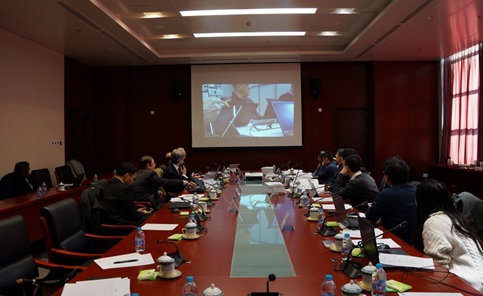
The headquarter of CEPRI (Chinese Electric Power Research Institute) in Beijing, China, received R&D Nester for the presentation of results of the project entitled "Substation of the Future" to a panel of experts from CEPRI and several universities in China.
This project was developed by R&D Nester, a research and development center owned by REN (Portuguese TSO) and State Grid Corporation of China.
The goal of this three-year project was to develop the specification for the next generation of PAC (protection, automation and control) systems for transmission substations.
The project had the following main steps:
- Writing of the "Vision" document - the base for the project, containing ideas, concepts and concerns.
- Writing of the "Reference Guide" document - containing requirements for the PAC system, from all stakeholders that use it.
- Construction of the simulation center, a set of hardware and software items, for the testing of the specified system.
- In parallel, specification of the PAC system.
- Finally, the execution of test, as a proof of concept of the developed system.
The initial set of tests included equipment from several international reference manufacturers of protection and automation systems and communication devices.
These devices were integrated in the simulation center, which main element is a RTPSS (real time power system simulator), enabling the execution of closed-loop tests, in which the RTPSS simulates a part of the Portuguese transmission network, interacting with the secondary system (protection and automation).
In this project, due to its increasing importance, the study of the communication network in the substation has been addressed. To do this task, a network analyser and generator (hardware) was integrated in the simulation center and the RTPSS was used to perform co-simulation, which is the combined simulation of the power system and the communication network.
The international standard IEC 61850, which main purpose is the interoperability of devices from different manufacturers, was used to specify and configure the system, using a third-party tool.
Regarding IEC 61850, it was tested the conformance of the data models and services of the IEDs and the interoperability comprising GOOSE and Sample Values communication between IEDs and client-server communication (MMS) between IEDs and the local SCADA.
The IEDs were assembled to form a control and automation system of an Extra High Voltage transmission line, connected to the RTPSS. Interaction between IEDs was tested functionally, including distance and overcurrent protection functions, reclousure, emission of commands from local and national and local SCADA, acquisition of sampled values from the merging units by the main unit, sending of the measurements to the local SCADA, redundancy between IEDs, acquisition of time synchronization using PTP protocol.
The performance of the communication switches was also tested, by measuring latency and jitter and transparent clock behaviour.
The executed tests confirmed that the system was properly designed and can be applied to a real substation.
As a result of this project, several scientific and technical papers have been published, namely:
- 'A joint research on the substation of the future between Portugal and China", presented at APAP (Advanced Power System Automation and Protection), held in Nanjing, China, in September 2015.
- "Enhanced testing platform for the Smart Substation", presented at PAC World Conference, held in Ljubljana, Slovenia, in June 2016.
- "Integrated Simulation Model of Power System Protection Schemes and Process Bus Communication Networks", presented at the EPEC (Electrical Power and Energy Conference) 2016, held in Ottawa, Canada, in October 2016.
- ;"Using the IEC 61850 formal description capabilities towards a vendor-independent PAC specification" presented at the CIGRE Colloquium ‘Building Smarter Substations', held in Mexico City, in November 2016.
Also, a provisory patent was successfully submitted.
The work performed allows Network Operators to prepare their substations specifications and new deployments to the benefits and challenges of new "smart" network capabilities.